
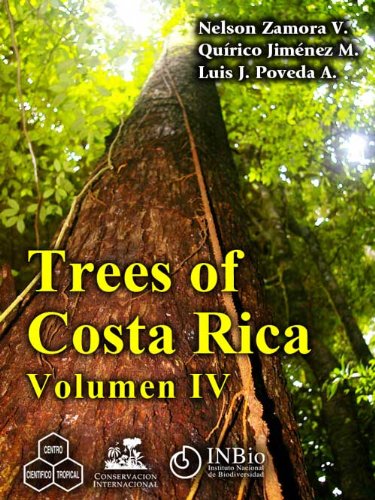
Trees of Costa Rica vol. IV
Product details
| Management number | 233594340 | Release Date | 2026/06/27 | List Price | US$7.67 | Model Number | 233594340 | ||
|---|---|---|---|---|---|---|---|---|---|
| Category | |||||||||
This volume is part of the process toward terminating the “Trees of Costa Rica”, a major project whose purpose is to improve the identification, study and conservation of the principal element of our forest ecosystems, the trees. This volume includes families that are very important in Costa Rican forests, due to their abundance and species diversity or because of the dominance of individuals of some species that play an important role in the canopy, such as the Fagaceae, Flacourtiaceae, Humiraceae, Lauraceae and Lecythidaceae.One of the most diverse and complex families treated in this fourth volume is the Lauraceae, which includes 124 species, representing 85% of all the species known for the family in the country (146). The other species are not included because they require more taxonomic study and more herbarium material is needed in order to prepare the illustrations.Lauraceae species are commonly called aguacatillos or “little avocados”. Most are found at middle to low elevations and some have significant abundance in montane forests. The most diverse genera are Ocotea, with 57 species (50 included in this volume); followed by Nectandra, with 16 (all are included) and Persea, with 15 (14 included). The Lauraceae are also characterized as one of the families of trees with a large number of endemic species (around 50 for Costa Rica, 31 of which are treated in this volume). Only 16% of the species (39) treated in this volume are endemic to Costa Rica, the rest are widely distributed in Mesoamerica or the Neotropics and a few have more regionally localized distributions, between Costa Rica and Nicaragua or Costa Rica and Panama. As such, this publication will also be useful for the entire Central American region.We should mention that this work not only includes trees of giant size, up to 50 m in height, such as Ocotea stenoneura, Lecythis ampla and Couratari scottmori, but also several shrubby or smaller species from genera like Buddleja, Malpighia or Xylosma. The size designation of trees (small, medium, large, very large and giant) follows the one that was used in volume I (see Holdridge and Poveda 1975). Read more
| ASIN | B005JFLM0I |
|---|---|
| XRay | Not Enabled |
| ISBN13 | 978-9968927741 |
| Edition | First edition |
| Language | English |
| File size | 21.3 MB |
| Page Flip | Enabled |
| Publisher | Editorial INBio |
| Word Wise | Not Enabled |
| Print length | 579 pages |
| Accessibility | Learn more |
| Screen Reader | Supported |
| Publication date | August 25, 2011 |
| Enhanced typesetting | Enabled |
Bestseller ranking
Fender Guards




Customers who viewed this product also viewed
Botany


Correction of product information
If you notice any omissions or errors in the product information on this page, please use the correction request form below.
Correction Request Form